Recycling and Sustainability at Clearance Sucks
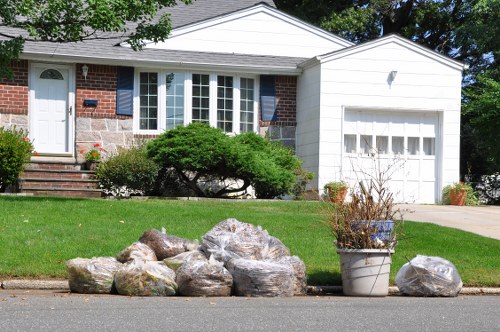 At Clearance Sucks we treat every clearance as an opportunity to recover value, reduce waste and support local communities. Our core mission is to divert as much material as possible away from landfill while providing clear, practical steps clients can take to lower environmental impact. We publish regular updates on our progress and evolve our practices to match the best available low-impact methods used across the region.
We work closely with local transfer stations and civic waste hubs to ensure that materials are sorted and routed correctly. Many boroughs in our operating area separate food waste, paper, cardboard, glass and mixed recycling at source; our crews are trained to respect those streams and to handle bulky items so they go to the right municipal or private recycling facility. By aligning with borough-level collection schemes we reduce cross-contamination and the need for secondary sorting.
 Our current recycling percentage target is 85% of all collected material diverted from landfill by 2028. This target is ambitious but achievable because we combine on-site sorting, partnerships with reuse organisations and precise routing to transfer stations. ClearanceSucks (and related teams operating under the clearance sucks name) log every load so we can measure weight, destination and final outcome, and we publish anonymised statistics to track progress.
Targets, Metrics and Accountability
We track multiple metrics: percentage diverted, tonnes donated, tonnes recycled and transport emissions per job. Our staged plan sets interim goals—75% diversion by 2025 and 85% by 2028—with continual reviews. Transparency is central: we share aggregated figures with local authorities and partner agencies to improve regional waste planning.Typical recycling and reuse activities we support include:
- Kerbside-style separation handled at the property: paper, cardboard, glass and cans.
- Bulky item reclamation: furniture refurbishment or charity redistribution.
- Electronics and WEEE processing through authorised outlets for repair, parts recovery and recycling.
- Textile sorting for reuse or fibre recycling, depending on condition and borough drop-off options.
 Partnerships with charities are a cornerstone of our approach. We have formal relationships with local community charities, social enterprises and reuse networks that take functional items for redistribution. Items that cannot be safely reused are routed to accredited recyclers. These partnerships reduce waste, support vulnerable residents and keep usable goods in circulation longer.
Low-Carbon Vans and Logistics
Transport emissions are a major part of clearance carbon footprints. Clearance Sucks operates a growing fleet of low-carbon vans—electric vehicles for urban jobs and hybrid units where longer runs are required. Our low-emission vehicles are paired with route optimisation software to minimise mileage and idling time, reducing CO2 and NOx emissions.We prioritise charging at renewable-powered depots where possible and use biomass-derived or sustainably sourced fuels only where electric options are not yet practical. Our drivers are trained in eco-driving techniques and in efficient loading practices that maximise every trip, which helps keep operational emissions down while increasing capacity for redistributable goods.
Working with local transfer stations allows us to make smart last-mile decisions. Instead of taking mixed loads directly to landfill or an overburdened transfer facility, crews divert recoverable streams to specialist sorting centres or charity warehouses. ClearanceSucks routes are designed to match borough collection calendars and bring material to the facility best equipped to handle it.
We recognise the diversity of borough approaches to waste separation—some require separated glass and food waste, others accept combined recycling with central sorting. Our teams adapt to local regulations and communicate clearly with clients about what can be left for kerbside collection, what should be boxed for charity pickup and which items need specialist handling.
 Community impact is measured not only by tonnes diverted but by social value generated through donations, repair workshops and training placements with our charity partners. Our formal agreements allow charities to collect suitable donations directly from our vehicles, or to receive consolidated drops at partner warehouses. This model creates consistent supply for second-hand markets and employment programmes.
![A large pile of discarded household appliances and metallic debris is situated outdoors on a paved surface, likely in an industrial or waste management yard. The collection includes white washing machines, metal cabinets, and various damaged electronic components, some of which are partially crushed or tipped over. The surface of the appliances displays signs of rust, dirt, and weathering, with rough textures and chipped paint visible on several items. Behind the pile, a dense mound of tangled dark metal wires and scrap merges into a chaotic heap, contrasting with the more structured shapes of the appliances. To the far left, a tall, narrow industrial tower stands against a cloudy, overcast sky that casts diffuse, subdued light over the scene. The environment suggests a site where rubbish such as electrical waste is being collected or processed, consistent with services provided by firms like Clearance Sucks, serving areas including the vicinity of [POSTCODE] or [TOWN], with an emphasis on recycling and sustainability practices in waste management.](/pub/_photos/rubbish/f1860795616.jpg) In practical terms, Clearance-Sucks manages sustainability through continuous improvement: quarterly audits of diversion rates, investment in cleaner vehicles and expanded charity networks. We use data-driven decision making to refine collection patterns and to prioritise routes that yield the most recoverable material per mile.
In practical terms, Clearance-Sucks manages sustainability through continuous improvement: quarterly audits of diversion rates, investment in cleaner vehicles and expanded charity networks. We use data-driven decision making to refine collection patterns and to prioritise routes that yield the most recoverable material per mile.
Our pledge is straightforward: to keep improving our recycling and sustainability performance while supporting borough-level waste strategies, local transfer stations and community organisations. Whether you read us as Clearance Sucks, ClearanceSucks or clearance-sucks, the goal is the same—fewer materials wasted, more value preserved and lower carbon journeys for every clearance.
What you can expect:
- Clear reporting of diversion rates and outcomes.
- Direct links to charities for reuse and redistribution.
- Low-carbon vans and smarter routing to cut emissions.
We continue to refine our operations and to work with councils, transfer stations and reuse partners to improve the circularity of every job. Thank you for supporting a smarter, greener approach to clearances and waste reuse.